


Truck Simulator EVO: Drive USA
4.61.03K Reviews
App Specs
- Version
- 1.2.70
- Updated On
- License
- Free
- Downloads
- 5,000,000+
- Developer
- Ovidiu Pop
- Categories
- Simulation
- Platform
- Android
Screenshots
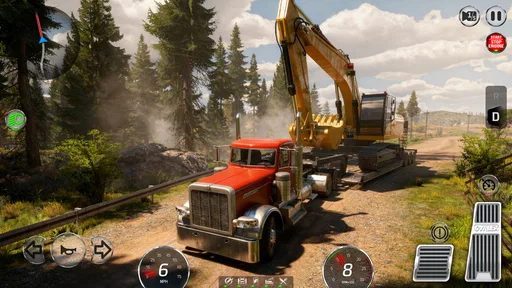
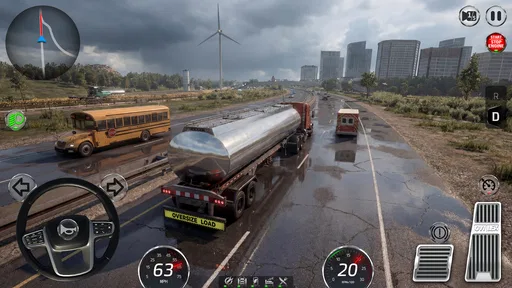
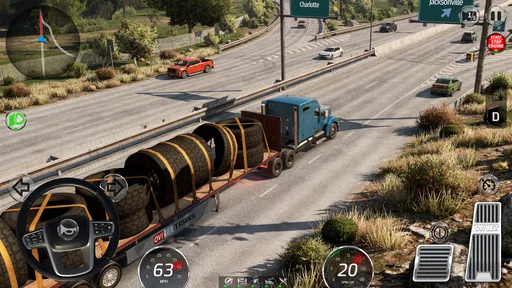
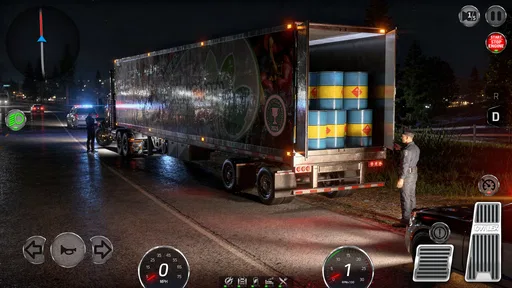
 Analysis by AppCompare
I approached Truck Simulator EVO: Drive USA as a decision rather than a quick download: does it offer the kind of truck-driving experience I would actually return to, or is it better treated as a short change of pace? After spending time with its cargo-focused simulation format, I found a game aimed at players who enjoy steady progress, road awareness, and the satisfaction of completing a long delivery more than constant action.
That distinction matters. This is not a racing game with a truck theme, and it is not built around instant rewards every few seconds. It places the appeal in driving American trucks through city streets and highways while handling transport work. The basic idea is easy to understand, but the slower rhythm asks for a little patience. When I wanted a relaxed driving session with a clear task, it made sense. When I wanted immediate excitement, it felt deliberately restrained.
What I considered before recommending it
The first question is what kind of simulation you want. If you like planning a route, keeping a large vehicle under control, and finishing a job without treating every corner as an opportunity to overtake, this game is naturally appealing. If you mainly want arcade handling, dramatic crashes, or a campaign driven by constant surprises, the truck-simulation approach may feel too measured.
I also looked at how approachable it is. The game is free to start, carries an Everyone age rating, and runs on Android devices using version 8.0 or later. That makes it relatively easy to try, especially for someone who has never played a serious mobile driving simulator. The free entry is useful because the appeal depends heavily on whether you enjoy the pace, not just whether you like the idea of trucks.
Its public reception gives it a reassuring starting point: it holds a 4.6 average from around 61 thousand ratings, with more than a million installs. I would not use that alone as proof that every player will enjoy it, but it does suggest that the central driving loop connects with a broad audience. The developer, Ovidiu Pop, is associated here with a focused simulation experience rather than a generic collection of unrelated mini-games.
My practical test was simple: could I play a delivery when I had limited time, and could I still enjoy a longer session when I wanted to settle in? The answer is yes, but with an important qualification. Short sessions are best when I treat them as a single job or a small driving exercise. Longer sessions become more satisfying when I accept that progress comes from consistency rather than dramatic changes from one minute to the next.
The driving rhythm rewards attention
What I like most is the change in mindset that comes with handling a truck instead of a small car. A turn needs more anticipation, a narrow street deserves more care, and a delivery is easier when I avoid rushing into mistakes. That makes ordinary movement meaningful. I found myself watching the road ahead earlier and leaving more room for corrections, which is exactly the kind of behavior I want from a simulation.
Worth Reading Before You Choose

Flipboard Shows What News Apps Must Do Beyond the Feed

Switching to Android Auto Means Rethinking Your Driving Routine

Google Calendar Makes a Crowded Week Easier to Manage

Ludo King Makes the Most of the Minutes Between Plans

Baby Panda World Brings Quick Play to Modern Phones, but Its Game Library Feels Busy

ESPN’s Live Game View Makes Following Close Games Easier
A useful tip is to slow down before a turn instead of trying to correct the truck halfway through it. This sounds obvious, but mobile controls can make late corrections awkward. I had better results when I prepared for the corner early, kept my movements small, and treated the camera as a tool for checking space rather than something to switch constantly without a purpose.
Another practical habit is to use the beginning of a delivery to settle into the controls. Rather than immediately chasing speed, I use the first stretch to judge steering sensitivity and braking response. That small pause saves time later, especially when the road becomes busier or the truck has to be positioned carefully near a destination.
Why the American setting changes the feel
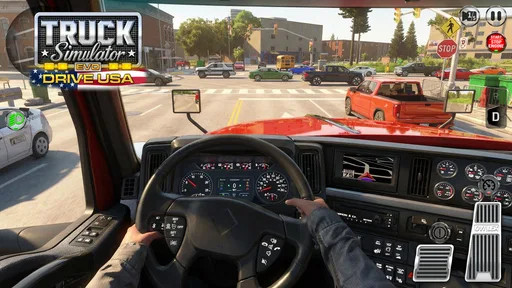
The US city-and-highway setting gives the game a useful identity. Urban roads create a different challenge from open highway driving: there is less room to recover from a poor line, and the truck feels more demanding when I need to turn or position it. Highways, by contrast, let me focus on maintaining a stable pace and reading the road ahead.
I enjoy that contrast because it prevents every delivery from feeling like the same exercise. A city section asks for precision, while a highway section gives the journey room to breathe. The game is at its best when I stop judging it by how quickly I can finish and start judging it by how smoothly I can complete the whole trip.
That also creates a realistic everyday use case. If I have a quiet evening and want something more involving than a podcast but less demanding than a competitive game, I can take on a delivery and play carefully. The session gives me a defined objective without requiring the same rapid reactions as a racing title. It is particularly suitable for players who enjoy routine tasks becoming satisfying through repetition and control.
Where this game wins over familiar alternatives
Compared with arcade driving games, this one wins through weight and purpose. An arcade alternative may be better for a quick burst of speed, but its roads often become a backdrop for overtaking and drifting. Here, the vehicle and cargo task give each trip a reason to exist. I am not simply trying to reach the finish first; I am trying to complete transport work while keeping the drive under control.
Compared with highly complex simulation games on larger platforms, the mobile format is more approachable. I can pick it up without committing to a long setup or learning an intimidating number of systems. That is a real advantage for someone who wants the feeling of a truck simulator but does not want the hobby to take over an entire evening.
The strongest hidden benefit is how well it supports deliberate practice. I can focus on one aspect of driving at a time: smoother steering, better braking, wider turns, or more patient highway positioning. Instead of treating every mistake as a failure, I use it to identify the part of my driving that needs work. That makes the game more rewarding than its simple premise might suggest.
I also think its free starting point changes the decision. A player can test the driving feel before deciding whether the game deserves regular storage space and attention. That is more valuable here than in a game whose appeal is immediately obvious from screenshots, because the real question is whether the handling and pace suit you personally.
Small habits that make deliveries less frustrating
I recommend beginning with a conservative driving style. Keep the truck stable, avoid treating every open stretch as a reason to accelerate aggressively, and give yourself time to line up with the road. The goal is not to prove that the vehicle can be driven recklessly; the goal is to finish the delivery with fewer corrections.
When a route moves from highway to city streets, I mentally change modes. On the highway, I look farther ahead and maintain a predictable line. In the city, I reduce speed earlier and pay more attention to the truck’s turning path. This simple switch helped me avoid carrying highway habits into tighter spaces, where they become costly.
I also found that repeated short practice can be more useful than one long, careless session. If I am struggling with steering, I would rather replay a manageable delivery while concentrating on smooth inputs than continue for a long time while becoming frustrated. That approach is especially helpful on a phone, where the screen and controls can make small errors feel larger than they would with a physical controller.
Finally, I would play with a clean screen and comfortable grip. That is not a game feature, but it affects this particular experience more than it does many casual titles. Truck driving depends on seeing the road and making measured inputs. Finger placement, glare, and accidental touches can undermine a good run, so the physical setup is part of getting the best from the game.
Where another type of game may suit you better
This is not the right choice for everyone. If your priority is fast competition, a racing game will probably deliver stronger immediate excitement. If you want deep vehicle customization, management systems, or a long economic strategy layer, you may prefer a more specialized simulator. I would also steer impatient players toward an arcade alternative, because the careful pace here can feel like work when you are not in the mood for it.
Players who dislike repeating similar driving tasks should think carefully before committing. The appeal comes from improving control and completing transport runs, so repetition is part of the design rather than a problem that disappears after a few minutes. I enjoy that loop, but I understand why someone else might call it slow.
There is also a control trade-off. Touchscreen driving can be convenient, but it does not provide the same physical feedback as a controller or wheel. I sometimes had to concentrate more on finger movement than on the road, particularly when I was trying to make a small adjustment. If precise physical controls are essential to your enjoyment, a console or PC simulator may be a better fit even if it requires more setup.
The in-app purchase range is another factor to keep in mind. The game is free, while optional purchases range from ninety-nine cents to forty-four dollars and ninety-nine cents per item. I would treat those purchases as a personal spending decision, not as a reason to download the game immediately. First establish whether the driving loop holds your attention without spending; that makes it easier to judge any later purchase calmly rather than paying to solve first-session impatience.
That is the main cost of switching from a familiar alternative: you must adapt to a slower definition of success. In a racing game, improvement may mean a faster lap. Here, improvement can mean a cleaner turn, fewer corrections, or a delivery completed with better control. If you switch without changing that expectation, you may think the game lacks excitement when it is actually asking for a different kind of attention.
What the version and platform mean in practice
The current version is 1.2.55, and the minimum Android requirement is 8.0. For a player deciding whether to install it, those details are reassuringly straightforward: it is not limited to only the newest phones, but compatibility still depends on the device meeting that operating-system requirement. I would check available storage and keep the phone comfortable to hold before starting a long session, because simulation games are less enjoyable when the device becomes an afterthought.
The Everyone rating makes it easier to consider for a shared household device, although parents should still make their own decision about screen time and optional spending. The rating tells me the game is broadly accessible in age terms; it does not replace personal judgment about whether a child is ready for a driving simulation with in-app purchases.
For someone moving from another truck game, I would not expect the transition to be completely automatic. The useful adjustment is to stop chasing the most dramatic route and focus on the quality of the drive. Give yourself a few sessions to learn how the truck behaves, especially during city approaches. That is the real switching cost, and it is modest if you already enjoy simulation games.
My recommendation for different kinds of players
I recommend this game to people who want a free mobile simulation centered on American truck driving, cargo work, and the contrast between city roads and highways. It is a strong choice for relaxed sessions, for players learning to enjoy deliberate vehicle control, and for anyone who likes turning an ordinary delivery into a small personal challenge.
I would skip it if you need constant action, competitive multiplayer energy, or a deep management experience before you can have fun. I would also avoid spending money immediately. Play enough to decide whether the handling, pace, and repeated delivery structure fit your habits. The free entry makes that trial possible, so there is little reason to rush the financial decision.
My clearest advice is to judge it after you have played with patience rather than after a hurried first attempt. Use the early part of a route to learn the controls, slow down before turns, and treat highways and city streets as separate driving problems. Those habits reveal the game’s real strength: it makes careful progress feel worthwhile on a phone.
Overall, Ovidiu Pop has made a simulation game that knows its audience. It does not try to disguise truck driving as a racing spectacle, and that honesty works in its favor. With a 4.6 average, around 61 thousand ratings, and more than a million installs, it has clearly found a substantial audience, but my recommendation is still based on the experience itself: choose it when you want a calm, task-focused drive, not a nonstop arcade rush.
For me, that makes it an easy game to recommend selectively. I would install it for a quiet commute break, a relaxed evening, or a short practice session when I want something structured. I would reach for a racing game when I want speed, and a deeper desktop simulator when I want more complexity. Within its own lane, however, this free truck-driving game offers a convincing reason to take the long way through an American city or highway.
Pros
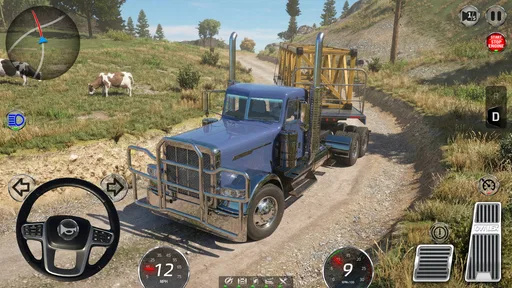
- Large USA map offers varied routes and changing scenery.
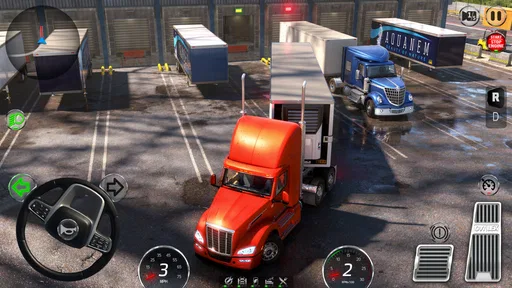
- Wide selection of trucks with different performance characteristics.
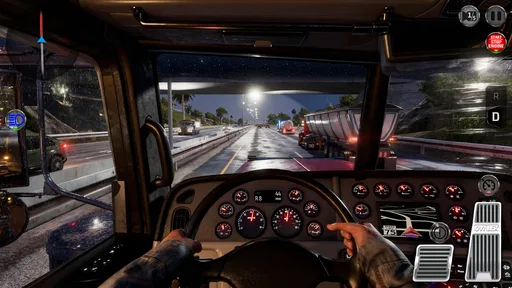
- Realistic traffic and weather effects make trips feel more immersive.
- Truck customization lets players personalize their vehicles.
- Offline play is useful when traveling without an internet connection.
Cons
- Some trucks and features require lengthy progression or in-app purchases.
- Controls can feel awkward on smaller phone screens.
- Traffic AI occasionally behaves unpredictably at intersections.
- Long deliveries may become repetitive after extended play.
- Performance can drop on older or lower-end devices.
FAQs for Truck Simulator EVO: Drive USA
What is Truck Simulator EVO: Drive USA?
Truck Simulator EVO: Drive USA is a driving and transportation game focused on operating heavy trucks across American-style roads and highways. After starting with a basic vehicle, you can take delivery jobs, earn money, explore different routes, and gradually improve your fleet. The game is designed for players who enjoy realistic trucking mechanics, long-distance driving, vehicle customization, and a slower, more methodical gameplay experience.
Is Truck Simulator EVO: Drive USA free to download and play?
The game can generally be downloaded without an upfront purchase, but players should check the current store listing because availability, pricing, and included content may vary between Android and iOS. Some features, trucks, upgrades, or other resources may be offered through in-app purchases. Advertising can also be part of the free experience, so users who prefer uninterrupted gameplay should review the purchase information before downloading.
Does the game require an internet connection?
Truck Simulator EVO: Drive USA may allow some driving and career activities to work offline, but an internet connection can still be necessary for advertisements, updates, cloud-related functions, purchases, or certain online features. In my experience with games in this category, offline availability can also depend on the device and installed version. It is best to launch the game once while connected before planning a completely offline trip.
Is Truck Simulator EVO: Drive USA suitable for beginners?
Yes, beginners can play Truck Simulator EVO: Drive USA, although the controls may take a little practice. Truck handling is less agile than driving a normal car, and braking, turning, traffic awareness, and delivery timing require patience. New players should begin with shorter routes, learn the control layout, and avoid spending all their early earnings immediately. Once the basic driving rhythm becomes familiar, progression feels considerably more comfortable.
What devices are needed to play the game smoothly?
The exact requirements depend on the Android or iOS version, but Truck Simulator EVO: Drive USA generally performs best on a reasonably modern phone or tablet with sufficient free storage and updated system software. Older or entry-level devices may experience slower loading, reduced graphics quality, overheating, or occasional frame-rate drops. Before installing, check the official store requirements and close background apps if performance is not stable.


